Trunk
Trunk provides a CI reliability solution that automates flaky test management, integrates with various tools, and supports DevOps teams in maintaining CI health.
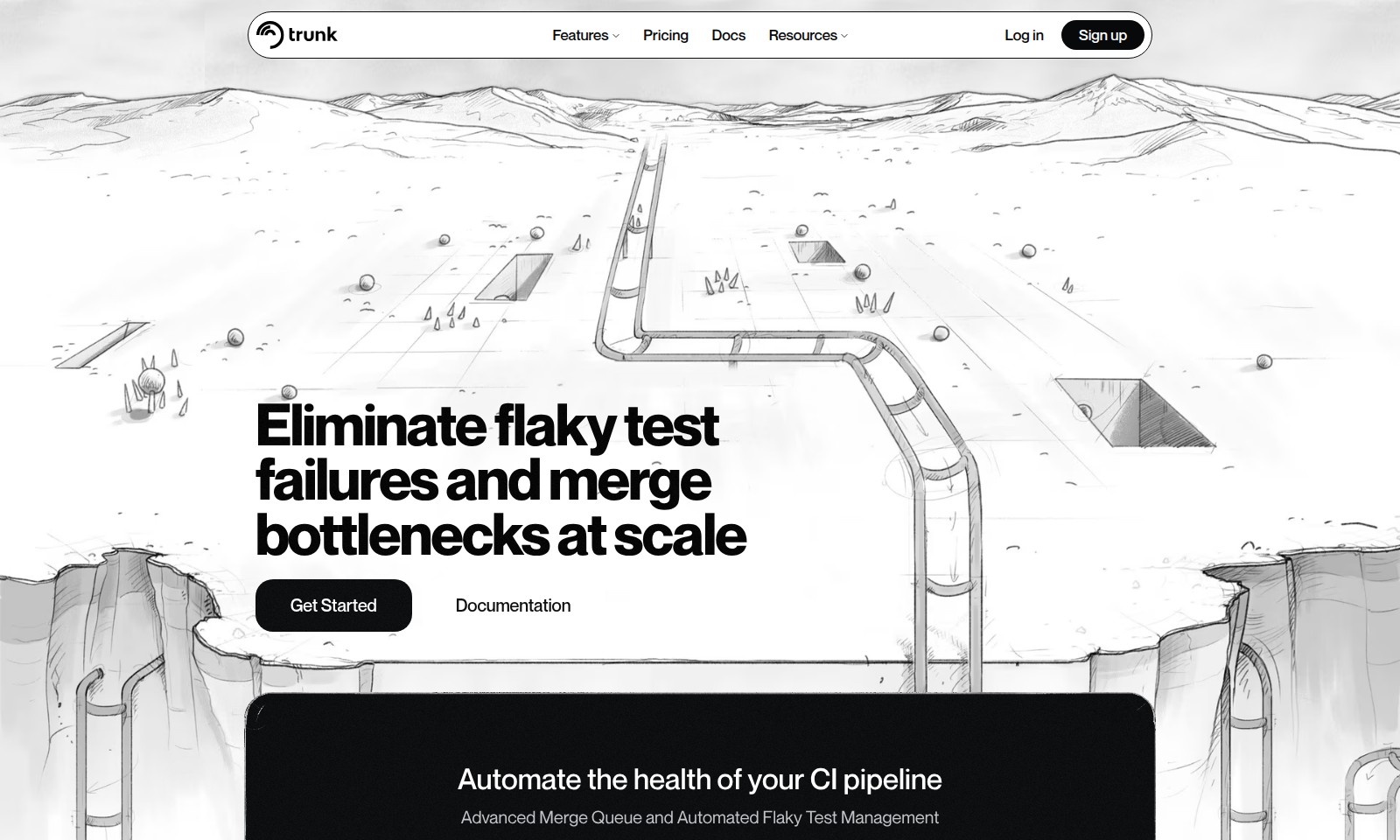
Trunk Introduction
Innovative Solutions for CI Pipeline Health
In the ever-evolving landscape of software development, maintaining the integrity of your Continuous Integration (CI) pipeline is crucial. Our platform offers advanced solutions to eliminate flaky test failures and merge bottlenecks at scale, ensuring a smoother development workflow and faster deployment cycles.
Trunk Features
Advanced Merge Queue - Streamlined Integration for Teams
Improve team collaboration and efficiency with innovative merge management tools. Our Advanced Merge Queue allows users to integrate their code seamlessly while eliminating bottlenecks associated with traditional workflows.
Automated Flaky Test Management - Ensuring CI Health
Automate the identification and resolution of flaky tests. Our advanced tools help maintain the integrity of your Continuous Integration (CI) pipeline by quickly identifying tests that cause instability, reducing unnecessary regression runs and keeping your pipeline healthy.
Flaky Test Detection - Proactive Quality Assurance
Automatically detect, quarantine, and eliminate flaky tests, irrespective of language or test runner. Our intelligent system proactively manages flaky tests to ensure your team spends less time on debugging and more on development.
Quarantine Flaky Tests - Optimized CI Performance
Speed up your CI process significantly by automatically quarantining flaky tests. This feature allows you to continue collecting stack trace information on failures without the need for repetitive test re-runs, thus enhancing overall performance stability.
Test Status History - Enhanced Transparency and Control
Gain insights into your test environments with a comprehensive status history. This feature enables teams to track when a test becomes flaky or broken, providing clarity on test quality over time and facilitating timely interventions.
AI-Powered Failure Analysis - Smart Insights for Developers
Utilize AI to analyze failures and deliver actionable insights. Our AI-powered analysis tool spots duplicate failures and provides concise summaries of what went wrong, helping developers quickly identify root causes and improve test reliability.
Integrated Ticketing - Seamless Collaboration with Jira and Linear
Enhance your team's workflow by connecting to Linear or Jira for automatic ticket creation and updates. This integration ensures that issues are documented in real-time, allowing for faster resolutions and improved project management.
Frequently Asked Questions About Trunk
FAQs
Q1: How does your service help eliminate flaky test failures?
Our service automatically detects and quarantines flaky tests within your CI pipeline. By effectively managing these tests, we reduce false positives and ensure a more reliable testing environment.
Q2: Can I integrate your service with existing tools?
Absolutely! Our platform supports integrations with popular tools like Linear and Jira. This allows for automatic ticket creation and updates based on test statuses, streamlining your workflow.
Q3: What happens when a test is identified as flaky?
When a test is flagged as flaky, our system automatically quarantines it. This means that it won't cause additional test runs, allowing the CI pipeline to continue running smoothly while still collecting vital information on the failure.
Q4: How can I be informed about flaky tests in my pull requests?
We provide detailed test summaries in pull requests, along with webhook support for integrations with platforms like Slack. This ensures that your team is promptly notified about any flaky tests that need attention.
Q5: Is your service language-agnostic?
Yes, our platform supports any programming language and any test runner, making it a versatile solution for teams using diverse tech stacks.
Q6: What features are included for failure analysis?
We utilize AI-powered technology to analyze failures, helping you identify duplicate failures and understand the root causes. This analysis is crucial for addressing underlying issues and improving your CI pipeline's health.
How to Use Trunk
Step 1: Sign Up for an Account
Begin by visiting our website and clicking on the 'Sign up' button. Fill out the required fields with your email and choose a strong password. Verify your email to activate your account.
Step 2: Log In to Your Account
Once you have activated your account, return to the website and click on 'Log in'. Enter your registered email and password to access your dashboard.
Step 3: Set Up Your Profile
After logging in, navigate to your profile settings. Upload a profile picture and fill out any additional information. This helps personalize your experience and makes it easier for the team to assist you.
Step 4: Explore Key Features
Take a guided tour of the website to familiarize yourself with the key features. Pay special attention to the tools designed to eliminate flaky tests and automate CI pipeline health.
Step 5: Connect Your CI Provider
Go to the integrations section and select your CI provider. Follow the prompts to connect and authorize access, which will enable automated management of your testing processes.
Step 6: Set Up Automated Flaky Test Management
Once your CI is connected, enable the new advanced merge queue feature. This will help you detect and quarantine flaky tests automatically, thereby speeding up your CI processes.
Step 7: Monitor Test Status History
Keep an eye on your test status history. This section allows you to see when tests become flaky or broken, providing insights into your testing health.
Step 8: Utilize AI-Powered Failure Analysis
Leverage AI features to analyze test failures. This will help you spot duplicate failures and give you summaries of potential issues, leading to quicker debugging and resolution.
Step 9: Create and Update Tickets Automatically
If you are using Linear or Jira, set up automatic ticket creation and updates. This integration streamlines your workflow and ensures issues are tracked effectively.
Step 10: Stay Informed with Test Summaries
Regularly check test summaries in your pull requests (PRs), and stay connected with notifications to platforms like Slack. This will keep you updated on any flaky tests that need your attention.
Reviews
Pros
- Easy to use
- Fast processing
- Great results
- Affordable pricing
Cons
- Limited free version
- Requires internet connection
Comments
No comments yet. Be the first to share your thoughts!
Trunk - Alternative Platforms
For some alternatives to Trunk that you may need, we provide you with sites divided by features.

AssemblyAI offers robust Voice AI models to enable innovative voice applications, ensuring top-notch accuracy and seamless scalability for developers.
Tiptap offers an AI Toolkit for creating document-editing agents, featuring templates, collaboration tools, and extensive customizability.
Explore the platform for creating customizable AI companions, avatars, and agents that enhance business processes with full control and zero fees.
Vana is an open network for user-owned data, enabling individuals to trade data tokens, access real datasets, and build data collectives.